
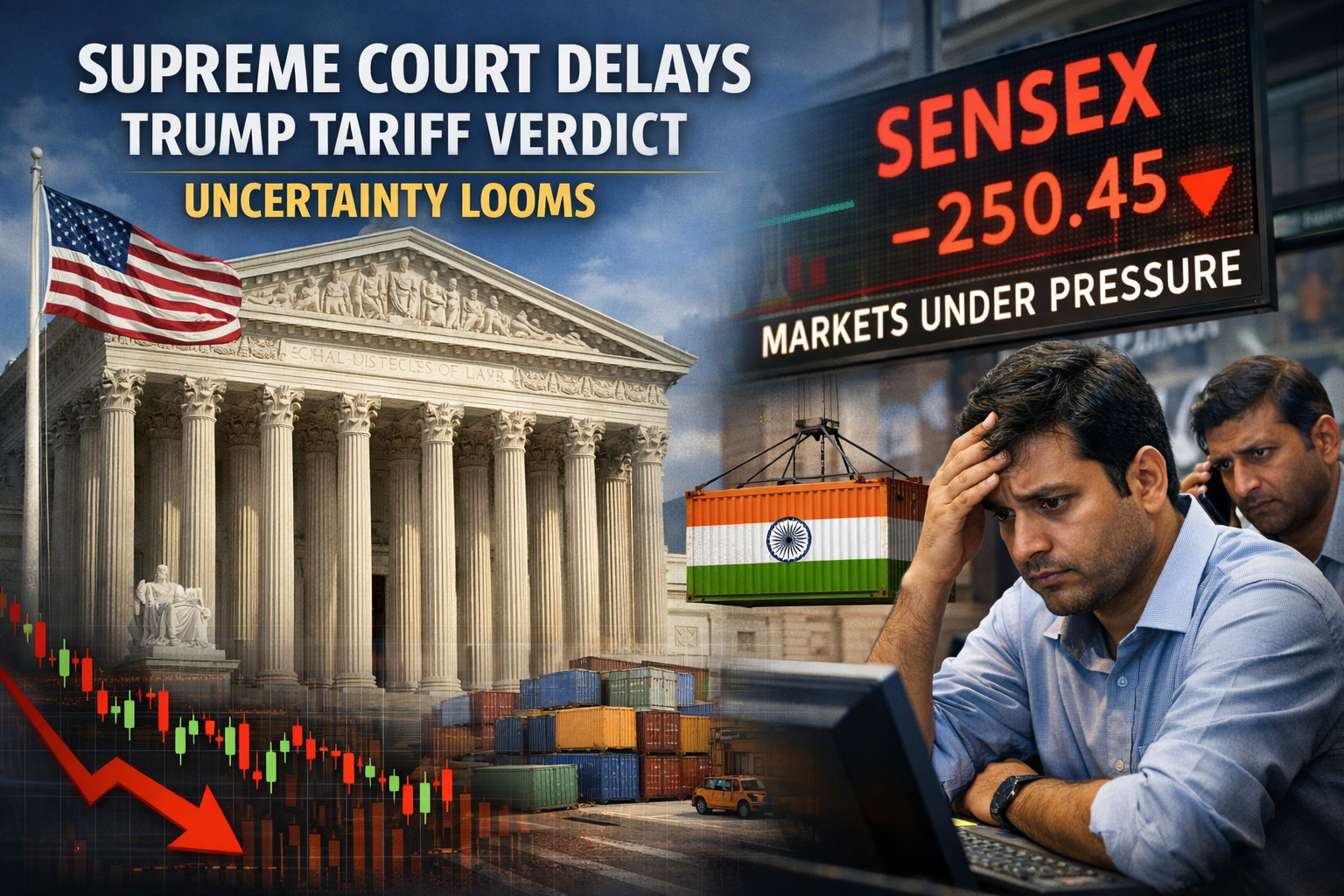
 US Supreme Court Postpones Trump Tariff Ruling — Indian Shares Remain Cautious
In a development that’s keeping financial markets on edge, the U.S. Supreme Court has again delayed its much-anticipated ruling on the legality of former President Donald Trump’s sweeping tariff policy, leaving both U.S. and global markets in a state of uncertainty.
What’s Happening in the U.S.?
Investors around the world were bracing for what could have been a landmark decision on whether Trump exceeded his authority in imposing tariffs under emergency powers. Legal challenges centered on whether such tariffs can be enforced without explicit congressional approval — a question with far-reaching implications for U.S. trade policy and global commerce.
However, rather than delivering a definitive verdict, the Supreme Court postponed its decision, extending the period of market uncertainty and leaving traders and policymakers alike guessing about the future of U.S. tariff law.
Indian Markets Feel the Ripple Effect
Indian benchmark indices such as the Sensex and Nifty have largely traded flat or slightly lower amid this ambiguity, as investors continue to weigh the possible outcomes of the U.S. court’s eventual ruling.
In recent sessions:
Investors have paused after a streak of losses, choosing caution over aggressive buying.
Broader market sentiment remains fragile as the looming tariff decision could impact foreign demand for Indian goods, especially if elevated tariffs persist.
Why This Matters to India
The broader context is that the Trump administration had previously imposed exceptionally high reciprocal tariffs targeting countries with significant trade surpluses, including India. These measures — raising levies on Indian goods to as high as 50% — significantly raised the cost of Indian exports and dampened sentiment in sectors like IT, manufacturing, and commodities.
Though some duties might be challenged or rolled back if the court strikes them down, certain tariffs — especially those justified on national security grounds — could remain in place even after the ruling.
Market Reaction & What Investors Are Saying
Analysts say the delay itself is a risk factor:
A ruling against the tariffs could lead to relief rallies, particularly among export-oriented segments.
A decision upholding the tariff regime would sustain higher costs and could further weaken sentiment among risk assets.
Until the Supreme Court delivers clarity, volatility is likely to remain a defining feature of both Indian and global markets.
Uncertainty Weighs on Global Sentiment
Markets dislike ambiguity, and the lack of a definitive outcome has increased risk aversion globally. Investors are reluctant to make aggressive bets when future trade rules remain unclear. Export-oriented economies are particularly sensitive, as tariffs directly affect competitiveness, margins, and demand.
The delay has also raised concerns that trade policy could once again become a political tool, especially with global elections and geopolitical tensions shaping economic decisions.
Indian Markets Stay Cautious
Back home, Indian stock markets have shown signs of fatigue, with benchmark indices like Sensex and Nifty trading in a narrow range or facing mild declines. While domestic fundamentals remain relatively stable, external headwinds are clearly influencing investor mood.
Key reasons Indian markets are under pressure include:
Foreign Institutional Investors (FIIs) adopting a wait-and-watch approach
Concerns over export demand, especially in sectors exposed to U.S. trade
Ongoing global uncertainty around interest rates, geopolitics, and trade policy
Even fundamentally strong stocks have seen limited upside as investors prioritize capital preservation over risk-taking.
Impact on Indian Exports and Businesses
India exports a wide range of goods to the U.S., including pharmaceuticals, textiles, engineering products, and IT services. Any continuation or expansion of high tariffs can:
Reduce price competitiveness of Indian exports
Impact earnings of export-heavy companies
Slow down order inflows and capacity expansion
Small and medium exporters are particularly vulnerable, as they operate with thinner margins and limited ability to absorb higher duties
How Should Investors Respond?
For retail investors, this is a time for caution rather than panic. Experts recommend:
Avoiding impulsive decisions based on headlines
Focusing on companies with strong balance sheets and domestic demand
Diversifying portfolios across sectors and asset classes
Maintaining a long-term perspective despite short-term volatility
Markets have historically rewarded patience, especially during periods of global uncertainty.